
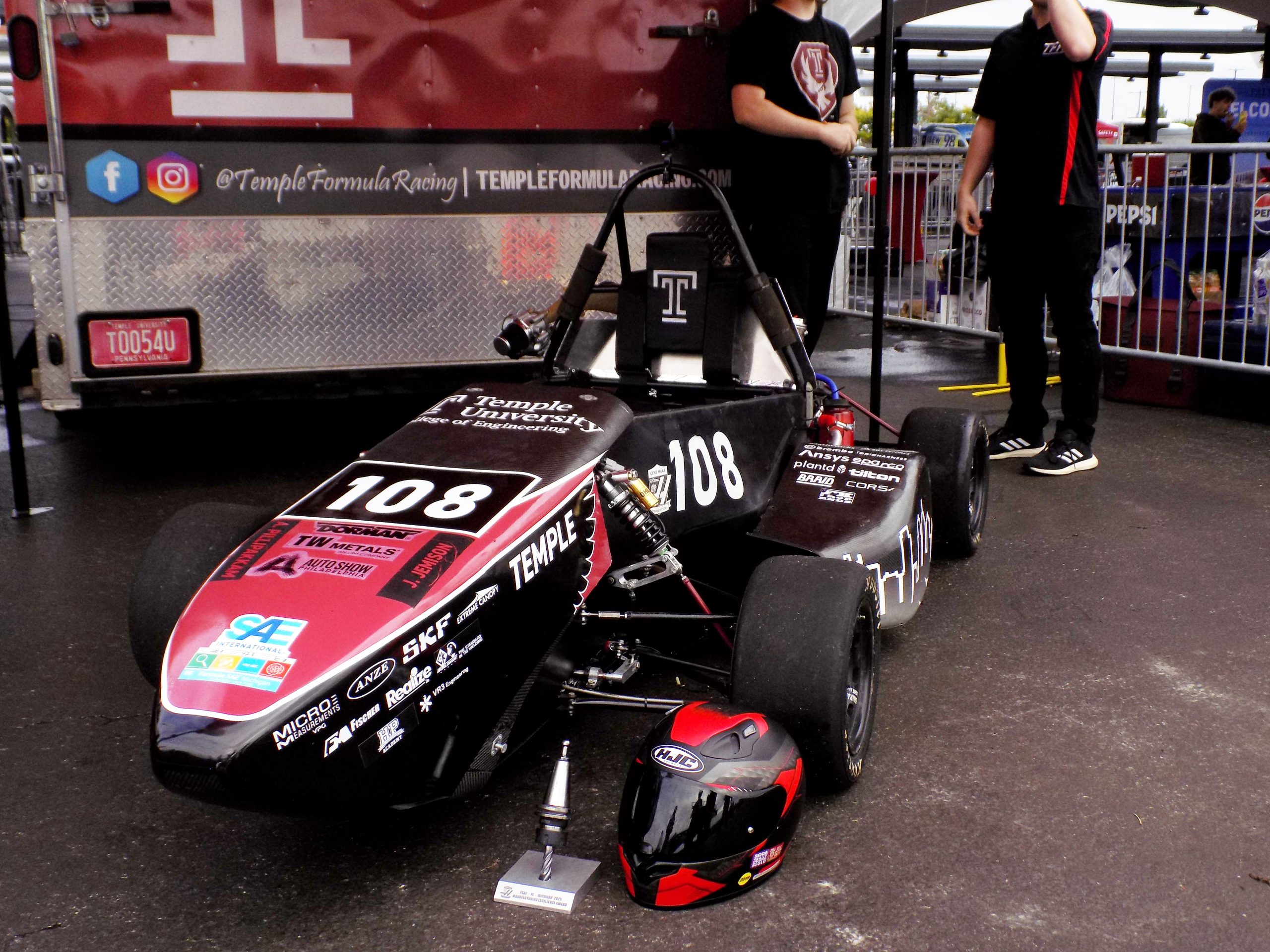
When Exton, PA, native Anand Bohm arrived at Temple University in 2023, he did not expect a business communication course to become one of the most practical foundations for his leadership in collegiate motorsports.
Yet Business Communications (BA2196), taught by professor Melissa Glenn at the Fox School of Business, played a pivotal role in preparing him for high-level competition with the student organization Temple Formula Racing (TFR), a chapter of the Formula Society of Automotive Engineers.
More than a communication class, BA2196 is designed to simulate real-world professional demands. Glenn structures the course around applied exercises—business case role-play, comparing AI vs. human written prompts, and in-class presentation practice—that encourages students to build upon their strengths and expand upon what they know.
“I ask that my students remember two things about writing for business that will serve them well beyond my class—clarity of task and assessment of audience(s) since they may need to adapt per company, country and industry,” Glenn said.
For Bohm, those lessons translated directly to the competitive environment of collegiate car racing.
From classroom to competition
Open to students from every major, TFR competes against universities from around the world in the FSAE Michigan Internal Combustion Competition. TFR designs, manufactures and builds most of the car themselves, testing the vehicle at Temple’s Ambler Campus on weekends.
A management information systems major, Bohm was tasked last season to be the TFR Business Team Lead responsible for the following competition components: budget management (worksheet optimization, invoice tracking, breakdowns), cost event (cost report, cost scenario) and business event (request for proposal or RFP, presentation). The team also had to write a 10-page RFP outline and produce a 10-minute virtual presentation.
The BA2196 Advantage

Fox School business communications professor Melissa Glenn. (Photo courtesy of the Fox School, Temple University)
Anand Bohm credits his business communications course (BA2196), taught by Fox School of Business professor Melissa Glenn, for sharpening the skills that helped contribute to TFR’s performance.
Those skills include:
- Audience awareness and professional tone: Business communication is not about proving you are right—it is about building bridges.
- Structured writing and clarity: Through assignments that require adapting tone, refining drafts, and analyzing communication missteps, BA2196 trains students to write concisely and strategically.
- Presentation confidence: In-class presentations prepare students to deliver content with professionalism and poise—an outcome rooted in repeated classroom rehearsal and feedback.
In fact, Bohm returned to Glenn’s classroom to present to four BA2196 sections, demonstrating how classroom principles can be applied directly to a global competition.
“Temple offered me the environment to have the experience I’ve had so far, and it was a major goal of mine to feel like a part of this campus when I first came here,” Bohm said.
Beyond communication
Glenn also fosters an environment centered on respect, accountability and growth. By recognizing students’ individual strengths and emphasizing that business communication builds on—rather than replaces—previous writing knowledge, she encourages confidence.
“Writing, particularly for business, is no cake walk, and the course pace really picks up. We are asking students to make a significant shift from what they’ve always known about writing,” Glenn said.
“Highlighting their strengths and having a bit of practical and collaborative fun in the process helps make the work more doable. Plus, it encourages students to think about how they might make use of assignments in real time,” she continued.
For Bohm, that translated into leadership maturity. Managing a six-figure operational budget, working closely with teammates across Temple’s many schools and colleges, and restructuring manufacturing timelines using project management tools requiresclear communication and strategic thinking.
He noted that while technical execution is essential in motorsports, the ability to articulate value, justify cost and inspire a team often determines competitive outcomes.
The real competitive advantage
The connection between BA2196 and TFR illustrates something larger about experiential education at Temple. Classroom learning, when grounded in real-world applications, becomes a competitive advantage.
For Bohm, business communication was not just a course requirement. It was preparation for the starting line.
“There are a lot of memories I would never have built if it weren’t for student life at Temple,” Bohm said.