
As artificial intelligence (AI) continues to become embedded within most professional industries, congruent to its growth have been ethical and moral debates surrounding its technology.
Given the many questions around this timely topic, it’s only fitting Temple University’s new institute dedicated to promoting responsible business welcomed industry professionals to consider potential answers.
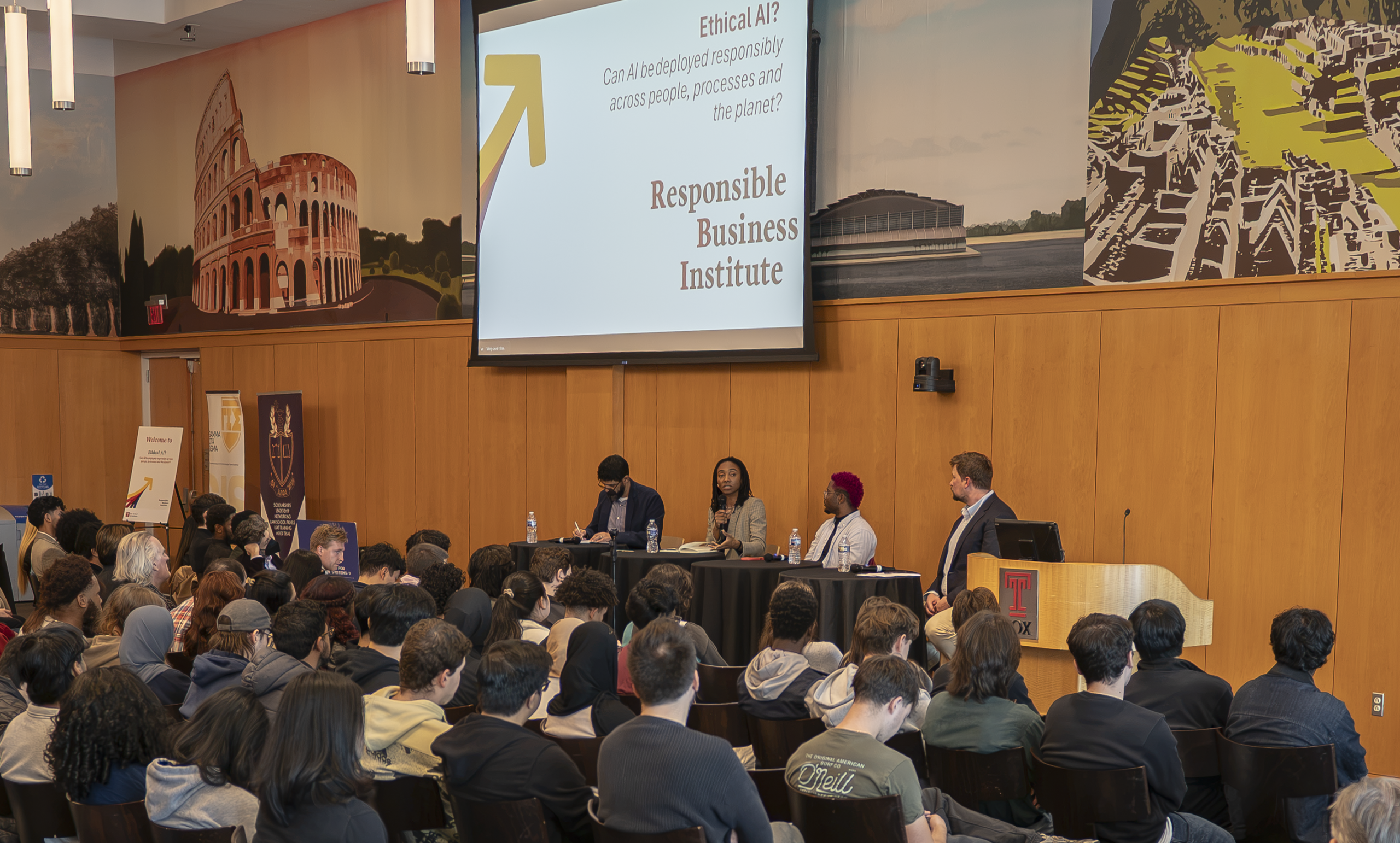
After officially opening its doors in the fall 2026 semester, Temple’s Responsible Business Institute (RBI) hosted a panel of AI subject-matter experts for its launch event “Ethical AI? Can AI be deployed responsibly across people, processes and the planet?” on Oct. 26.
A cross-campus collaborative effort, RBI, housed in the Fox School of Business, is the university’s hub for research, dialogue and innovation pertaining to the subject of responsible business.
Moderated by Brian Hutler, assistant professor at Temple’s College of Liberal Arts and RBI faculty fellow, panelists for the event included Sarah Murphy Grey, the head of responsible AI for Google Cloud at Google, Iyad Obeid, professor and chair of electrical and computer engineering at Temple’s College of Engineering, and Christopher Persaud, CLA ’17, a senior researcher and program manager from the Responsible AI team at Intel.
After opening remarks by Fox School Dean Chip Hunter, Leora Eisenstadt, RBI’s director and associate professor in Fox’s department of Risk, Actuarial Science, Healthcare Management and Legal studies, introduced the event.
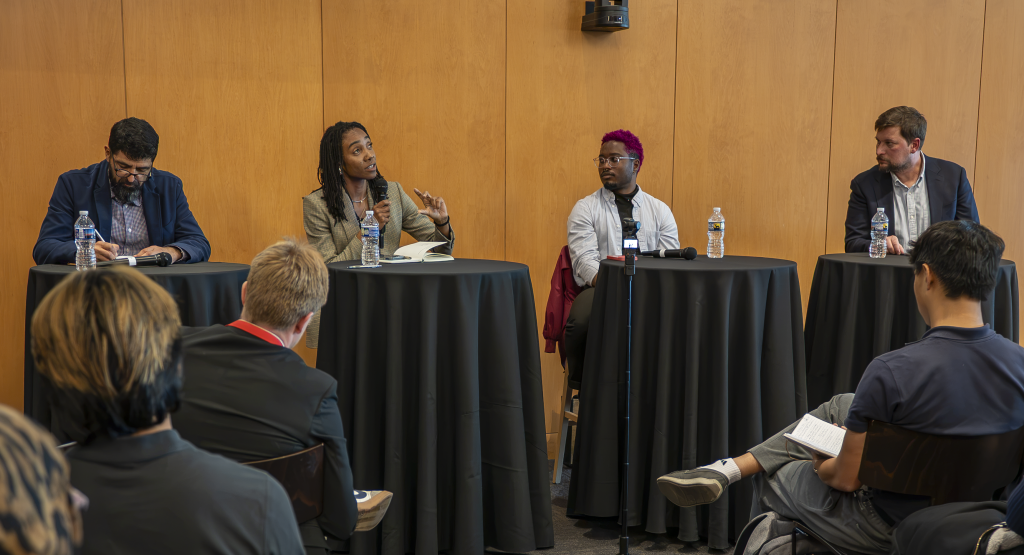
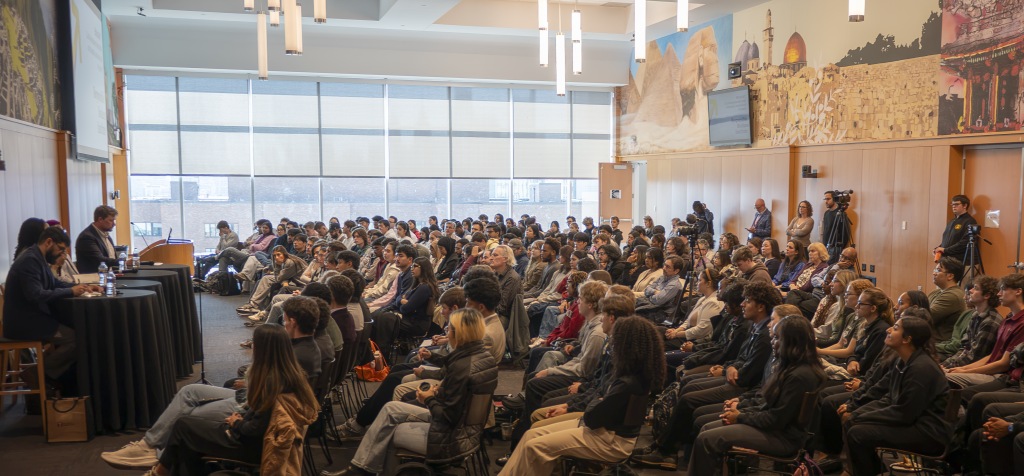
Held inside the Fox School’s Alter Hall, an audience that included students, faculty, staff and university stakeholders were treated to a rich conversation around many topics pertaining to the ethics and future of AI from those who knew the subject best.
Early in the conversation, the panelists were given a chance to offer unique commentary when explaining how their roles and professional responsibilities directly relate to the concept of “responsible AI.”
“Anytime we have a product or create something new, we want to think through what the potential risk is to humans and what kind of impact it’s going to have on the world—
both good and bad,” Murphy Grey explained.
“A not-so-fun part of my job, but an important aspect of it, is to outline to our engineers all the potential risks associated with a new technology, and utilizing a test called the ‘human rights impact assessment,’ we can examine whether a product could cause physical harm, societal harm, representational harm or simply how humans are represented in the new technology.”
Persaud found similarities in his role at Intel.
“A lot of my work is doing intra-educational work with engineers and helping them understand that the choices they make influence the choices that other people make,” Persaud said.
“So, a lot of my job is educating about social harms and how, even though engineers might think their roles or actions are removed from it, the technology they are developing needs to take certain societal elements into consideration.”
Similarly, the topic of biases in AI technology, like when considering gender or race, was examined.
“As humans, we all have gaps—and since humans built AI—those gaps are also a part of AI,” Murphy Grey said.
“It’s important to ask: is this product or technology built for everyone? Is my use going to reflect how everyone else uses it? Will it give me a similar or appropriate response for everyone else in this room?”
With many students in attendance, the topic of how they can be better prepared for their future careers with the existence of such technology was also raised. In addition to Obeid encouraging students to learn how to utilize AI as a tool to make you better at your job, Murphy Grey also gave advice on how to stand out.
“I would heavily encourage you to become an expert in something,” Murphy Grey said.
“When I started out, the concept of responsible AI was very niche, and it was not something that was very well known. However, my expertise and niche are quantitative studies as it relates to inequalities, which does tie into responsible AI.
“When I came into Google, they had a bunch of engineers, but they didn’t have social scientists.”
Bigger picture concepts, like what the future entails as AI continues to grow, were also discussed. For Obeid, he mentioned the immediate positives that came to mind.
“AI tools are getting unbelievably powerful, and I think a great impact it will have is treating a lot of medical illnesses that have stymied us for as long as there’s been humans,” Obeid said.
“The ailments that have been true nuisances—cancer, dementia—all the illnesses that take away our loved ones from us as they get older—I think a lot of those will be mitigated relatively quickly, thanks to the power of AI.”
Murphy Grey shared her thoughts on the future, too.
“For me, I start thinking about all the ways these different AI systems that we use right now can be combined, and think about what that means for society,” Murphy Grey said.
“Like I mentioned, humans created and helped develop AI—so all the next steps that happen—it’s not just one engineer’s decision or my decision or your decision—it’s the compound decisions that we make as a society that leads us to the outcome.”
Overall, the event served as a successful launch for RBI.
“Today’s event truly exemplified the mission of RBI, which is to bring together academic and industry professionals from a range of disciplines to tackle some of the thorniest issues facing businesses today—all while providing our students with in-depth conversation, knowledge and insight,” Eisenstadt, RBI’s director, said.
“We chose this topic almost a year ago, as it emerged out of discussions with RBI faculty fellows and with students who told us that this was on their minds and something they would like to hear from the experts on. The industry professionals we welcomed today are leaders in responsible AI in their organizations and can speak to the work on the ground, and how they are trying to shape the adoption of AI and the creation of new AI tools.
“I hope the students emerged from this discussion with a further sense of the complexity of the issues surrounding AI use and development, with some appropriate hesitancy when they use AI tools themselves and with a determination to continue to learn and discuss this issue.”